
Caught Early: Intelligence Is Scaling, Execution Is Breaking
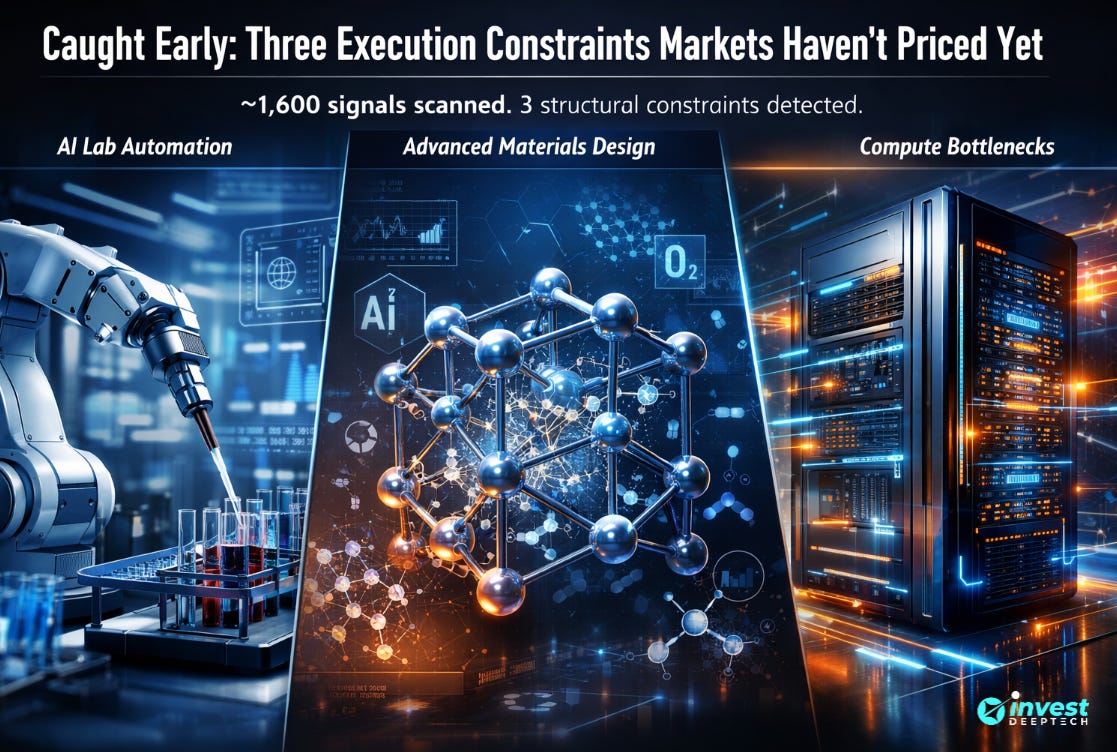
~1,600 signals scanned. 3 structural constraints detected.

DeepRadar™ Weekly Intelligence Brief
A signal intelligence engine detecting constraint pressure inside real-world systems
Scan Window: Mar 13 → Mar 17, 2026
DeepRadar Signal Scan
This report comes directly from DeepRadar™.
DeepRadar is the system I built to track how real technology systems evolve underneath the surface.
Every week I scan four types of signals:
Research papers
Patent filings
Government funding disclosures
Early-stage technical programs
These signals come from the industries that carry modern infrastructure.
Compute.
Biology.
Materials.
Autonomous systems.
Each of these systems produces thousands of technical signals every week.
Most of them are routine engineering work.
But occasionally those signals begin clustering around the same constraint.
When that happens, it usually means the system itself is encountering pressure.
That is the layer I watch.
Let Me Explain This Simply
When systems scale, they don’t just get better.
They get stressed.
More ideas are generated.
More systems are connected.
More data is moving.
At some point, something can’t keep up.
And when that happens, the system leaves clues.
Papers start testing the same limit
Patents try solving the same bottleneck
Funding moves toward the same problem
Those clues are what DeepRadar tracks.
What I Looked At This Week
During this window I asked one question:
If these systems keep scaling, where do they start slowing down?
Between March 13 and March 17, DeepRadar indexed:
~1,600 technical signals (modeled, constrained)
Breakdown
~1,000 research papers
~550 patent filings
~50 funding signals
Most of this activity is incremental.
Only a small portion touches real system limits.
After filtering and review, three signals stood out.
Signal Density
~1,600 signals → 3 structural signals
(~1 signal per ~530 outputs)
When signals compress like this, the system is adapting in very specific places.
Key Signals Summary
DeepRadar scanned ~1,600 infrastructure signals between Mar 13 and Mar 17, 2026.
After filtering, three structural signals emerged.
Macro Signal
Scientific systems are limited by how fast they can execute experiments
Micro Signal
Material systems are limited by what can actually be built
Compute systems are limited by energy and data movement
SIGNAL #1
AI Is Starting to Run Experiments, Not Just Suggest Them (MACRO)
AI can now generate more ideas than labs can test.
That changes the bottleneck.
What I Saw
AI generating full experimental instructions
Systems connecting AI directly to lab machines
Early closed-loop experimentation systems
This creates a new loop:
AI designs → machines run → results feed back → repeat
Why This Matters
The problem is no longer thinking.
It’s testing.
If one system can test 100 experiments per day
and another can test 10,000,
the faster system wins.
Business Leverage
Value moves to whoever controls execution speed.
Key layers:
automated labs (robots, biofoundries)
software connecting AI to experiments
high-throughput testing platforms
This becomes a control layer.
Every discovery depends on it.
Time Horizon
Now (0–18 months):
Used in advanced labs
Next (2–4 years):
Speed becomes competitive advantage
Later (4–8 years):
Autonomous labs emerge
SIGNAL #2
AI Is Learning to Reject Ideas That Don’t Work in Reality (MICRO)
AI can design many materials.
But most cannot be built.
What I Saw
Models embedding real-world constraints
Systems rejecting non-buildable outputs
Focus on manufacturability
This creates a loop:
generate → check → reject → keep only viable
Why This Matters
Before:
humans filtered results
Now:
systems filter themselves
This reduces waste and speeds up development.
Business Leverage
A new layer appears between idea and production.
Value concentrates in:
constraint-aware design systems
manufacturing-linked tools
IP built around buildable materials
This layer decides what reaches the real world.
Time Horizon
Now:
Used in R&D
Next (2–5 years):
Becomes standard in industry
Later (5–10 years):
All design becomes constraint-driven
SIGNAL #3
AI Systems Are Limited by Energy and Data Movement (MICRO)
The bottleneck is no longer compute.
It is moving data and managing energy.
What I Saw
Hybrid compute systems (analog + digital)
Photonic data movement
Designs minimizing data transfer
Why This Matters
Moving data:
costs energy
slows systems
increases cost
At scale, this becomes the real limit.
Business Leverage
Value shifts to infrastructure layers:
interconnect systems
memory and data movement
energy-efficient hardware
orchestration software
These layers control cost and performance.
Time Horizon
Now:
Used in specific deployments
Next (2–4 years):
Becomes standard in data centers
Later (5–8 years):
Fully hybrid systems
Validation Log
Scan window: Mar 13 → Mar 17, 2026
Signals indexed: ~1,600
Filtering stages
~1,420 incremental signals removed
~130 minor signals removed
~50 constraint-relevant signals
~12 reviewed
3 validated signals
Validation Criteria
Each signal must:
come from real technical sources
show a real system constraint
appear multiple times
have a clear real-world path
Final Signal Density
~1,600 → 3 structural signals
This confirms these signals are not random.
What This Means
Last week we saw systems struggling to coordinate
This week shows what happens next is systems struggling to execute
The Pattern
ideas are faster than testing
designs are faster than building
compute is faster than movement
The Shift
We are moving from: intelligence bottlenecks
To: execution bottlenecks
Where Value Is Moving
faster experimentation systems
buildable material pipelines
efficient compute infrastructure
These layers are not visible.
But they control everything.
🔒 Friday Focus
Constraint Investing → When Execution Becomes the Bottleneck
Last week we looked at coordination.
What happens when systems stop agreeing.
This week goes one step further.
What happens after coordination breaks
Systems don’t just become unstable.
They slow down.
The new constraint
Execution.
labs can’t keep up with AI
factories can’t build what is designed
systems can’t move data efficiently
The key idea
Every system now has a point where things slow down.
That point becomes the bottleneck.
Why this matters
Because bottlenecks create control.
If everything must pass through a layer:
whoever speeds it up controls the system
What I’ll break down
how to find execution bottlenecks early
how to identify control points
how to invest in execution layers
The new question
Not “what is improving?”
But “what cannot keep up?”
Because that’s where the next dominant companies will be built
Closing
Everything in this report comes from DeepRadar™:
research
patents
funding
When multiple signals point to the same constraint,
the system is adapting.
That moment is where real opportunity begins.
— Eden