

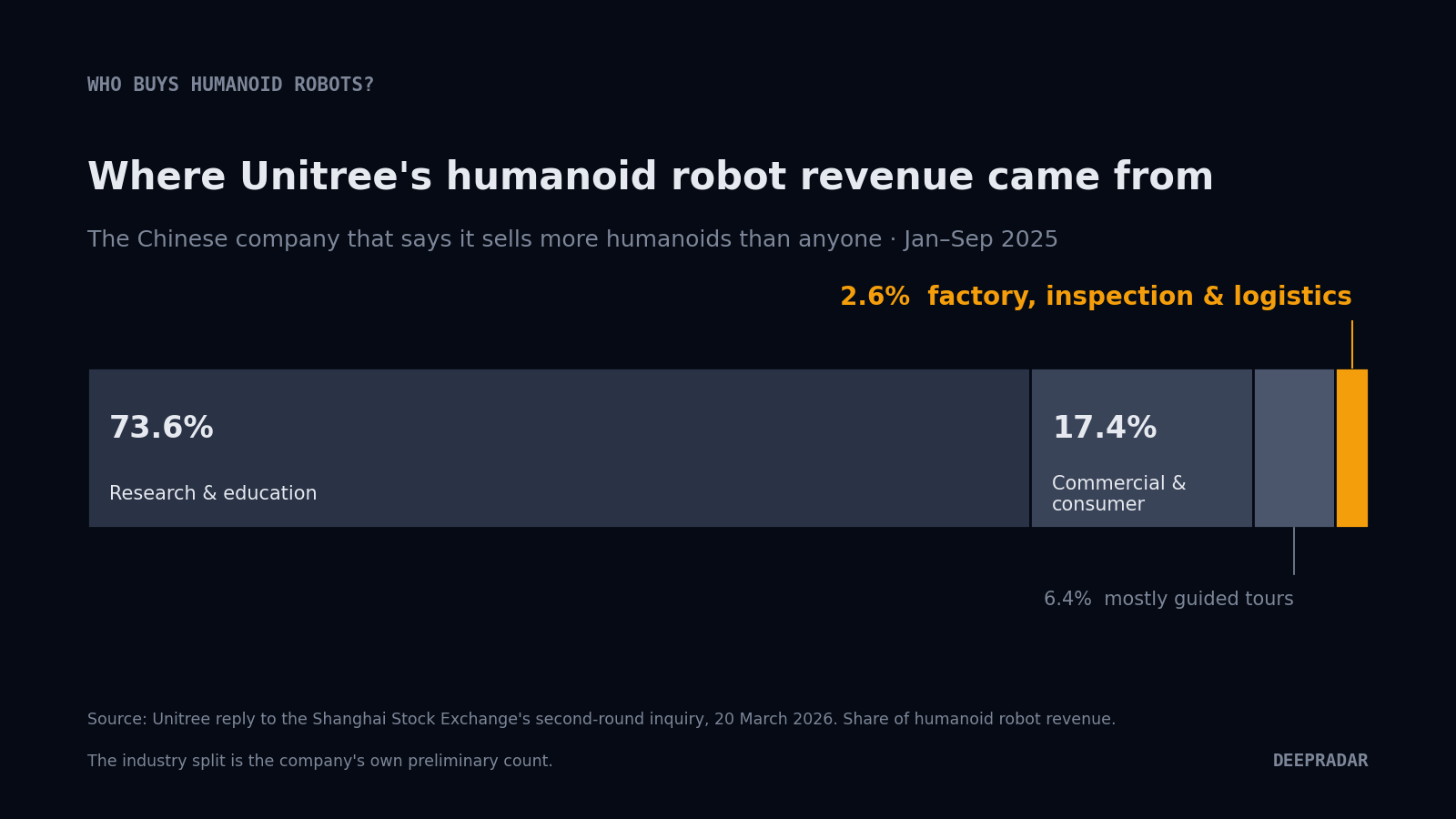
Caption: Unitree’s own filing: 2.6% of its humanoid revenue came from factory, inspection or logistics work.
In September, the humanoid robot industry announced more factory capacity than ever. In the same weeks, the best evidence yet came out on who actually buys these robots, and for what. Mostly research labs. Some shops and showrooms. Real factory work, almost none.
I’m Eden. Through DeepRadar, I check the assumptions investors are asked to believe before their investment committee signs off. I’ve been tracking this sector since May, and here’s what changed this month, and why it matters well beyond robots.
The factories
On 12 September, the Chinese company UBTech opened a plant in Liuzhou designed to build one humanoid robot every ten minutes, more than 10,000 a year. In the first half of this year, it reportedly sold about 900.
UBTech isn’t alone. Tesla says it is converting a car production line in California into a robot line aimed at a million units a year. Hyundai wants a factory for 30,000 robots a year by 2028.
The buyers
Four pieces of evidence arrived in the same fortnight.
The first came from the industry’s own statisticians. The International Federation of Robotics, which has tracked robot sales for thirty years, counted humanoids for the first time. In figures shared with Reuters, it found about 7,000 were sold worldwide in 2025 for industrial and professional use. Its secretary general said many went to research labs and companies using them to collect data for AI training. Factory trials usually involve fewer than ten robots, sometimes a few dozen.
The second came from Unitree, the Chinese company that says it ships more humanoids than anyone. When it applied to list on the Shanghai stock exchange, the exchange asked who its customers were. Unitree’s answer, signed by its chairman and its bank under legal liability, was that 74% of its humanoid revenue came from research and education. About 9% came from “industry”. But when Unitree looked inside that 9%, it could only identify about a third as factory, inspection or logistics work. Most of the rest, it said, was robots giving guided tours of corporate offices.
So real industrial work is under 3% of the humanoid revenue of the company that says it sells the most humanoids.
The third came from Agility Robotics, an American company going public by merging with a SPAC, a listed shell company that exists to buy a private one. Agility has said it holds $300 million in orders. Its merger filing with the US securities regulator explains what that means: 1,000 robots of a model that hasn’t launched yet, rented over three years, subject to milestones in the contract. The buyer is a related party, meaning someone with a financial connection to Agility. The contract also gives that buyer warrants, the right to buy Agility shares, linked to the robots. Agility’s total revenue last year was $1.78 million. Of that, $650,000 came from customers with no connection to the company.
The fourth came from the stock market. Reuters reported that Chinese regulators have quietly slowed down humanoid robot listings. They want to know whether revenue from government-backed projects reflects real demand. Unitree’s shares are down 55% from their peak.
What changed
For two years, the question about humanoids was whether anyone could build them in large numbers. That question now has an answer: yes, factories are being built.
The new question is harder. Who pays for the work these robots do, how much does that work cost per hour compared with a person, and is any of it written down anywhere an investor can check? So far, the honest answer is: not much, not yet, and rarely.
That doesn’t mean humanoids won’t work. It means an investor who is asked to believe “the demand is there, the factory is the bottleneck” is being asked to believe something the documents don’t show.
What this means for a deal
Say you’re at a fund, and a robotics company is going to your investment committee next month. The committee is the group that signs off on the investment. The company’s deck shows an order book, a factory ramp and thousands of units by 2027. Your valuation assumes that ramp turns into revenue on time.
The question that decides the price is this: for each year of the ramp, how many units have a named customer, a signed contract the customer can’t easily walk away from, and a real task that customer is paying for?
The answer puts you in one of four places:
Commit. The orders are firm, the buyers have no ties to the company, and at least one customer has shown what the robot costs per task against the person it replaces.
Condition. The orders are real but depend on milestones. Pay for the part that’s documented, and link the rest to the milestones being met.
Reprice. The valuation counts the whole order book as future revenue. Price it on what’s firmly contracted, and treat the rest as upside.
Pass. The orders lean on related parties and there’s no evidence of real deployment.
If you have a deal in this spot right now, reply to this email with the assumption. I read every reply.
This isn’t only about robots
The same gap appears whenever a company goes from its first working product to its first real commercial scale. A battery maker promising a gigafactory ramp. A fusion company promising a date for first power. A quantum computing company promising its first paying customer. A biotech promising that AI will speed up its path to the clinic.
In every case, the investor is handed a number someone else produced: the ramp, the order book, the launch date. If the fund has done twenty deals like it, it knows whether that number is reasonable. If it hasn’t, the number goes into the model unchecked.
Energy has the same pattern. On 14 September, Bell Canada and the government of Saskatchewan announced a 900-megawatt expansion of Bell’s AI data centre project, which Canada’s prime minister called the country’s largest sovereign AI network. The documents say something narrower. It’s a non-binding memorandum of understanding, meaning a statement of intent that commits nobody. It’s private money. It will run on a gas plant Bell builds and pays for itself. And it will be built in phases, as customers sign up. It’s a real plan, but it isn’t a commitment yet, and that difference matters to anyone putting a price on capacity for 2028.
What I do
DeepRadar helps investors decide whether to Commit, Condition, Reprice or Pass before the investment committee, by testing the one assumption the deal rests on.
I take that assumption, whether it’s the ramp, the order book, the grid connection or the launch date, and check it against the primary documents: filings, contracts, grid studies, regulatory records. Then I tell you how much confidence it deserves and what a more realistic range looks like. It takes five days. I’m independent of everyone in the deal, and you keep the decision and the valuation.
I also make my calls in public, with dates, so you can see whether I’m right. The next one lands by 12 October. The US federal energy regulator is deciding whether to let PJM, the grid operator for 13 US states, connect large data centres before there’s enough power to serve them, on condition that they’re switched off first in a shortage. In August I gave it 70% odds of approval with both parts intact. When the market watchdog asked the regulator to reject it, I cut that to 40%, before the result. I’ll grade it here either way.
If this is your situation
If you’re at a fund or a family office with a hardware, energy or deeptech deal heading to committee, and the price rests on a date or a number your team has no way to benchmark, reply to this email. One sentence on the assumption is enough. Within 48 hours I’ll tell you whether it can be checked, and how.
If you know someone in that position, forward this to them.
— Eden
P.S. When the regulator rules on PJM in October, I’ll publish the result here with the grade, right or wrong. Subscribe if you want to see how the call holds up.
Sources: Unitree Robotics, reply to the Shanghai Stock Exchange’s second-round questions, 20 March 2026. Agility Robotics and Churchill Capital Corp XI, Form S-4, filed 4 September 2026. International Federation of Robotics, via Reuters, 21 September 2026. Reuters, 14 and 21 September 2026. UBTech, 12 September 2026. Government of Canada and Bell Canada, 14 September 2026. I hold no position in, and receive no payment from, any company named.