
Three countries wrote big checks this week. The grid didn't notice.
DeepRadar is the intelligence layer being built for deeptech finance. The terminal is open during beta. Here's what showed up between June 4 and 12.

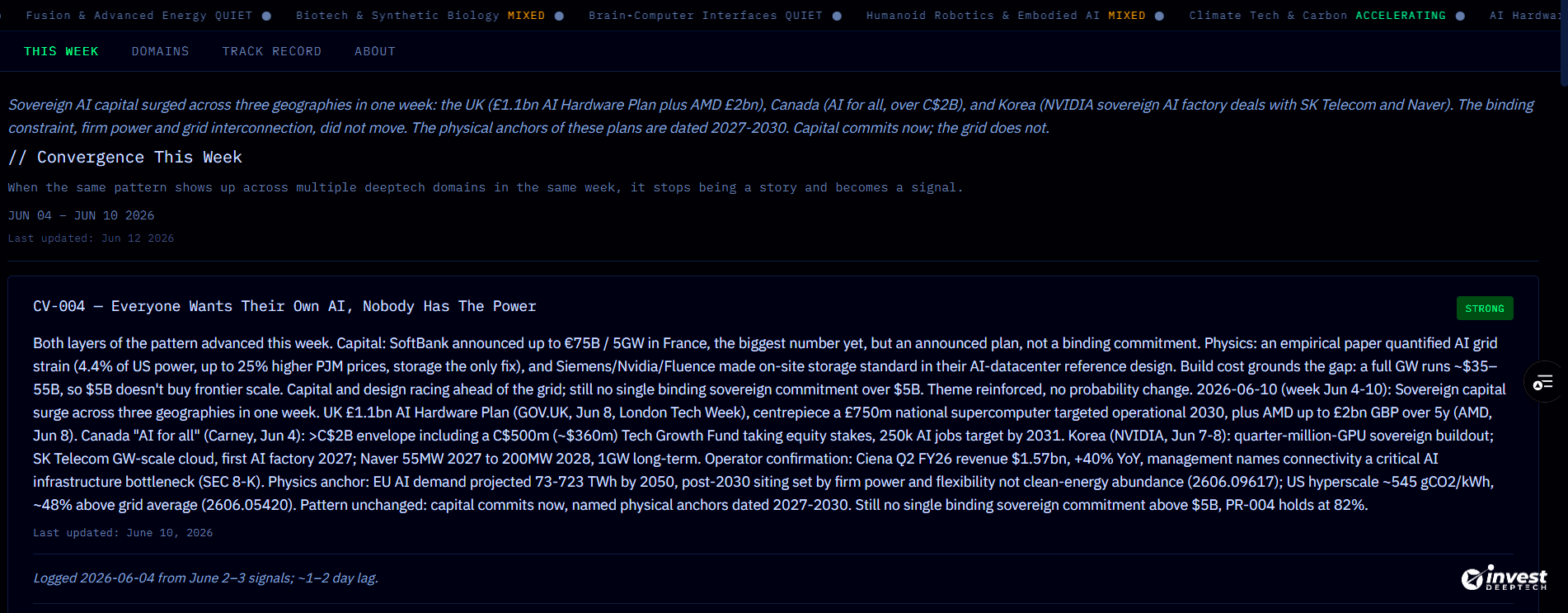
The CV-004 convergence entry this week: four sovereign AI commitments, zero movement on the binding constraint. Capital now, hardware dated 2030. (More on the DeepRadar terminal: console.deepradar.tech).
This week, three governments and one chip company committed to sovereign AI compute. Not one of them moved the constraint that decides whether any of it works.
Here’s what landed between June 4 and June 12.
The UK announced a £1.1bn AI Hardware Plan, with a £750m national supercomputer as the centerpiece. AMD committed up to £2bn to the UK over five years. Canada launched its “AI for all” strategy, over C$2B, including a fund that takes equity stakes in domestic AI firms and a target of 250,000 jobs by 2031. NVIDIA announced sovereign AI factory deals across South Korea with SK Telecom and Naver.
Four announcements. Three countries. One week. Read the headlines and the sovereign AI race just accelerated.
Read the dates instead.
“The capital is committed now. The physical assets are dated 2027 to 2030.”
The UK supercomputer is targeted operational in 2030. SK Telecom’s first AI factory is 2027. Naver goes from 55MW in 2027 to 200MW in 2028. The money is committed today. The hardware that money is supposed to buy is dated three to four years out.
That gap is the whole story, and it isn’t an accident. It’s the binding constraint showing through the press release.
A national AI supercomputer doesn’t need funding. It has funding. It needs firm power and a grid connection, and those run on multi-year lead times that money can’t compress. The same week these checks were written, a modeling study put EU AI electricity demand at 73 to 723 TWh by 2050 and found that after 2030, where you can build AI is governed by firm power and grid flexibility, not by how much clean energy exists. Separately, US hyperscale data centers were measured running about 48% above the grid-average carbon intensity. The physics is already binding. The announcements don’t touch it.
This is the same pattern, now at the scale of governments.
I’ve been tracking this dynamic across deeptech all year: capital arrives years before the physical constraint resolves. Quantum companies raised hundreds of millions while no one could yet run a production workload that beats a classical machine. Fusion has pulled in billions in private capital with no demonstration of net energy at power-plant scale. AI biotech launched platform after platform with zero approved drugs.
Now it’s national governments. Same shape. The announcement is loud. The delivery is dated 2030.
For anyone underwriting this, the question isn’t “how much was committed.” It’s “what’s energized, and when.”
So I dated it.
This week I logged a new public prediction on the terminal: the UK’s £750m national AI supercomputer is operational by December 31, 2030, or it slipped. I put it at 45%, leaning toward slip, because first-of-a-kind national compute plus grid interconnection almost never lands on the first stated date.
I won’t move that probability because more capital shows up. More capital is the thing that’s already happening. I’ll move it when the physical gate clears: a signed interconnection agreement and ordered hardware on a schedule that actually holds 2030. Not before.
That’s the whole method. Sharp prediction. Physical constraint. A date. No probability ratchet from narrative alone.
The weeks when nothing moves are the point.
The sovereign AI checks were the loud signal this week. Underneath them, the binding constraint didn’t move: no utility, no hyperscaler, no government has yet disclosed a specific project delayed because the power wasn’t there. Quantum stayed at baseline academic publishing. Fusion was quiet again. Brain-computer interfaces kept advancing upstream research while the question that matters, bandwidth that beats non-invasive alternatives, stayed unanswered.
A weekly report that always finds something exciting isn’t a signal system. It’s content. The honest version tells you when the field is loud and the physics is still stuck. This was one of those weeks.
The terminal is live.
Go to console.deepradar.tech and you’re in. Every published prediction, the evidence logged against it, and weekly takes across all eight domains, including the quiet ones.
If you run a deeptech fund or a corporate venture team and want this applied to your own thesis, constraint-anchored reads on the deals you’re actually weighing, I’m working with a small number of funds on custom engagements. Reply to this email or write to info@investdeeptech.io.
And if you want to argue with the UK 2030 call, even better. That’s why I publish them before they resolve. Disagreement is welcome, updates are public.
Capital is the easy part. Physics is the hard part. Watch which dates hold.
— Eden